Industry Information
Landscape Spike Light Buying Guide
A buying guide for importers and contractors: three aluminum IP65 landscape spike light bodies with GU10/MR16/G5.3 holders, carton data and sample checks.
Most landscape spike lights fail in the same place: not the LED, but the housing. A surface finish that chalks after one monsoon, a cable gland that lets water into the lamp cavity, a bracket screw that seizes after a season of irrigation — these are the returns that cost an importer more than the margin on the whole container.
This guide covers one product family we build in three body styles — aluminum, IP65, with a GU10/MR16/G5.3 lamp holder instead of a sealed LED module — and explains what to check before you commit a purchase order. It is written for importers, wholesalers, landscape contractors and hospitality procurement teams supplying Southeast Asia and the Middle East.
Why a holder-based spike light suits importers
A spike light with a GU10, MR16 or G5.3 holder takes a lamp the buyer chooses. That single design decision changes the risk profile of the SKU:
You are not locked to one LED module. If a supplier stops making a module, or a market shifts to a different colour temperature, you change the lamp, not the fixture.
The lamp is a local consumable. Distributors keep their own lamp stock and sell replacements. The fixture stays installed, which is the maintenance model hotels and resorts actually want.
One housing covers several SKUs. The same body ships with GU10, MR16 or G5.3 holders, so a market that standardises on MR16 and one that uses GU10 can be served from one production run.
Failure isolation is simpler. A dead lamp is a lamp swap, not a fixture replacement and a callback to site.
For a sealed integrated fitting, all four of those advantages disappear — and so does the repair revenue that a wholesaler can otherwise capture.
The three bodies in this range
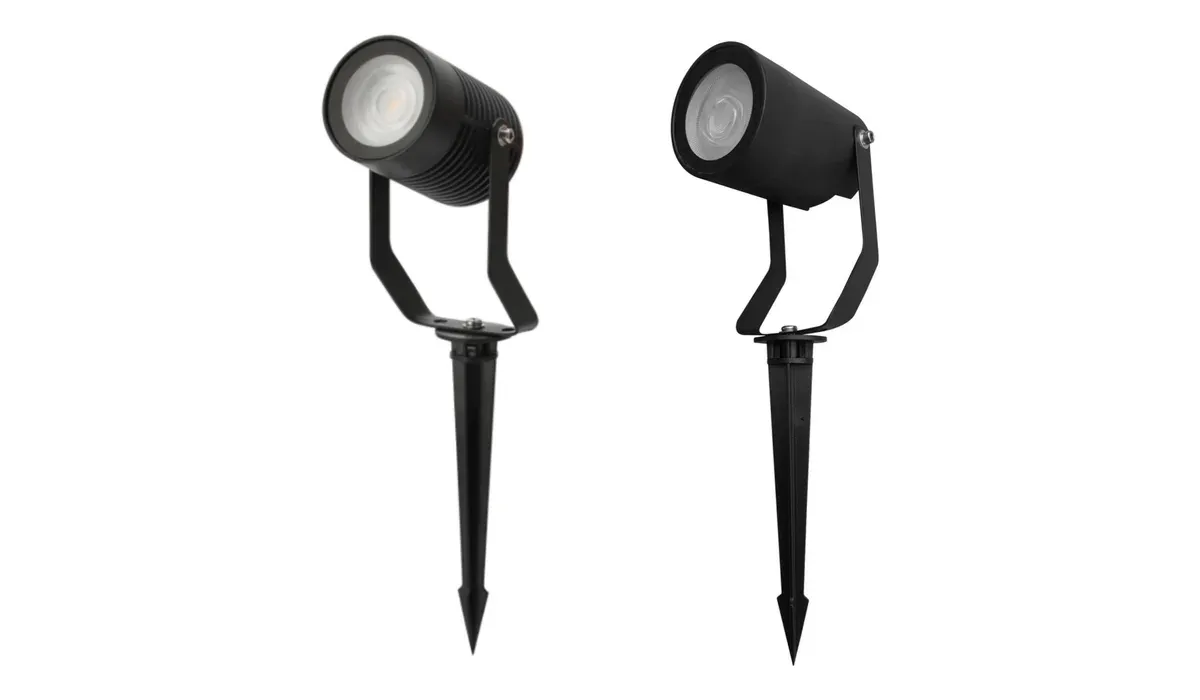
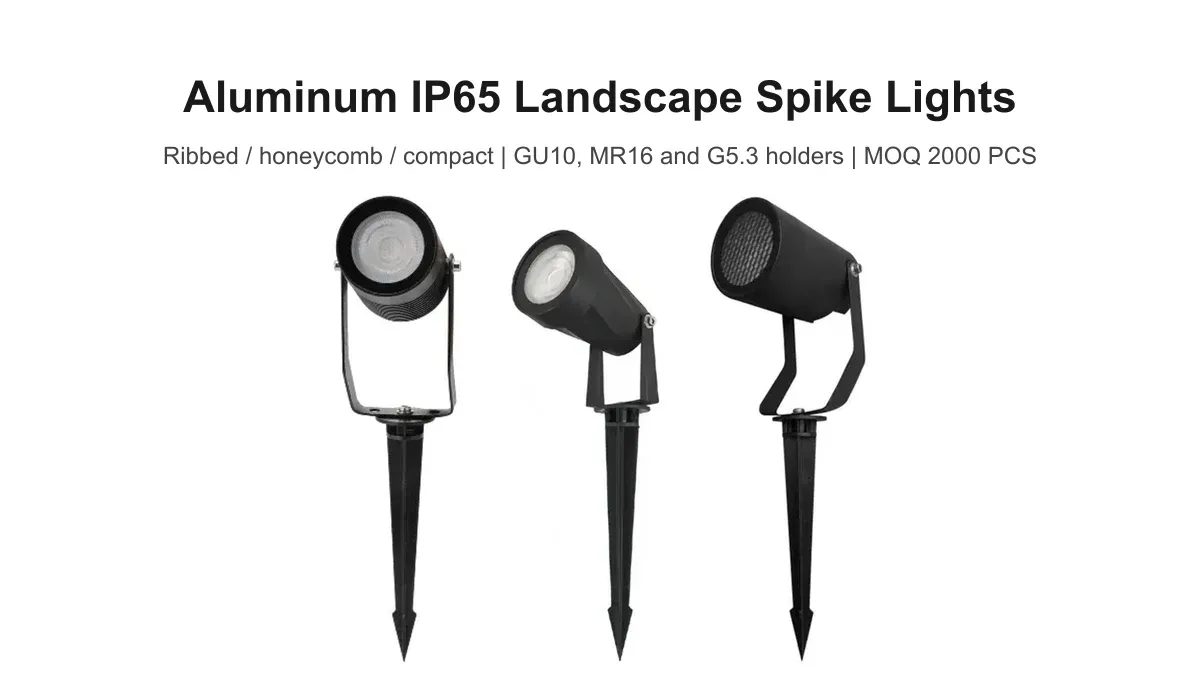
All three share the same construction logic: an aluminum body, an adjustable U-bracket with a locking screw, a ground spike, an IP65 rating, and a GU10/MR16/G5.3 holder. What differs is the body profile and the front lens, which is how you separate them by application and by price point.
Model | Body size | Front lens | Carton | Units per carton |
|---|---|---|---|---|
JD-9016 | 56 × H90 mm | Clear lens, ribbed heat-sink body | 35 × 35 × 35 cm | 50 PCS |
JD-9017 | 55 × H95 mm | Honeycomb anti-glare lens | — | — |
Compact spike | 55 × H80 mm | Clear lens, short body | 66 × 60 × 97 cm | 100 PCS |
The ribbed body on the JD-9016 is not decoration: the fins add surface area where the lamp sits, which matters when a buyer fits a higher-output GU10 than the fixture was originally specified for. The honeycomb lens on the JD-9017 breaks up the source into a softer, glare-controlled pool — the version to quote where the light is seen from a seating area, a restaurant terrace or a hotel walkway.
The links below go to the individual product pages, where the size drawing and the full specification table sit for each body:
JD-9016 landscape spike light — 56 × H90 mm, ribbed body, clear lens, 50 PCS per carton.
JD-9017 honeycomb spike light — 55 × H95 mm, honeycomb anti-glare lens.
Compact 55 × H80 mm spike light — short body, clear lens, 100 PCS per carton.
Choosing by application
Resort, hotel and restaurant landscaping. Glare control wins over raw output. The honeycomb version (JD-9017) is the safer default here: guests see a lit planting bed, not a bright point source at eye level. Specify the clear-lens body only where the fixture points away from seating.
Pathways, driveways and perimeter lighting. The compact 55 × H80 mm body does the job at the lowest material cost, and its 100-piece carton is the better freight unit when the order is measured in thousands. Aim the bracket slightly down the path rather than across it, so the pool of light reads as a route.
Garden beds, feature shrubs and facade grazing. The JD-9016 with its ribbed body and clear lens gives the tightest, brightest accent for uplighting a trunk or a wall. This is the version that sells where the buyer is lighting architecture rather than people.
Mixed project carts. Because all three share the holder and the bracket logic, a contractor can order one spike family for an entire project and vary the body by zone, without stocking three sets of spare parts.
What to check on a sample
IP65 is a claim on a label until you test the three places water actually enters a spike light. Ask for a sample and check these before approving a production run:
1. The cable entry. This is the single most common failure. Look for a proper cable gland with a rubber seal that compresses onto the cable jacket — not a hole with sealant around it. Pull the cable gently; it should not move inside the gland.
2. The front lens seal. The lens should seat against an O-ring or a moulded gasket, not bare metal. On the honeycomb version, confirm the mesh is captive and cannot be pushed inward.
3. The bracket screw. The locking screw that holds the head angle is exposed to rain and irrigation water all year. Ask what it is made of. A plain steel screw will seize; stainless or a coated screw will not.
4. The finish on edges. Run a fingernail along the spike tip, the bracket bend and the lens bezel. A coating is thinnest at sharp edges, which is exactly where aluminium starts to oxidise in coastal or high-humidity air.
5. The spike-to-body joint. The spike should thread or press into a solid collar. If the joint flexes when you push the spike into soil, it will loosen on site.
6. The holder fit. Insert a lamp of each type you intend to sell — GU10, MR16, G5.3. The lamp should seat firmly with no rattle and no force needed.
Ordering checklist
Send these points with your inquiry and you will get a quote you can compare against another factory's, instead of two prices that turn out to cover different products:
Holder type — GU10, MR16 or G5.3, and whether you want one holder type or a mixed run.
Body style — ribbed/clear-lens, honeycomb/anti-glare, or the compact body.
Finish — the three bodies shown here are supplied in black; confirm early if you need another colour, and at what quantity.
Lamp inclusion — these housings ship without a lamp. If your market expects a boxed lamp, say so up front so the carton and cost are quoted together.
Voltage and plug/supply arrangement — state the mains voltage and how the fixture will be connected on site.
Carton and pallet format — confirm carton dimensions and whether you need export pallets or a specific stacking pattern.
MOQ and lead time — 2000 PCS per model, 25 days production.
Sample quantity — ask for samples from the production run, not from a display set.
Freight and carton planning
Carton volume, not unit weight, usually decides the landed cost on spike lights, because they are bulky and light. Two details are worth pinning down early:
The carton figures published for this family differ substantially per piece between the compact body (100 PCS per carton) and the JD-9016 (50 PCS per carton), so do not estimate container loading from unit count alone — ask for the carton dimensions of the exact model you are buying and calculate from those. A mixed order of two body styles will not cube out the same way as a single-model order.
Also confirm how the spike is packed. A loose spike in a carton will damage the finish of the neighbouring unit in transit; a moulded tray or an individual sleeve costs a little more and prevents a claim.
Frequently asked questions
Is the lamp included?
No. These are housings with a GU10, MR16 or G5.3 holder installed. The buyer supplies the lamp, which is what makes local replacement and local lamp stocking possible.
Can the same body take GU10 and MR16?
Yes. The holder accepts GU10, MR16 and G5.3 lamps, so a single body can serve markets that have standardised on different lamp types.
What is the MOQ and production time?
2000 PCS per model, with 25 days production.
Are they suitable for coastal installations?
The body is aluminum with a coated finish and the fixture is IP65 rated. For coastal or high-humidity sites, specify this in the inquiry so the coating and the bracket screw specification can be confirmed for that environment.
Can we put our brand on the carton?
Yes — send the artwork and carton format with the inquiry so the packing and the print cost are quoted together.
Request a quotation
Tell us the body style, holder type, quantity per model and destination port, and we will quote from the Foshan factory with carton dimensions and lead time included. Send your inquiry through the contact form and we will reply with a specification sheet for the exact model you are considering.